Ishmael, Illinoise, Angels in America, Never Let Go, and working at a Christian summer camp.
This summer has been broad. I watched, did, and read so much that I want to talk about, but unfortunately, UT kicks off in three weeks, and I’ve been under a mountain of submission deadlines. So, in lieu of these circumstances, I’ve assembled my 2024 summer reading list.
This isn’t everything I’ve read, done, and seen this summer, more everything I’ve wanted to write about. Treat these as micro-articles, a list of coulda-been pieces that fell through the cracks in the past three months.
Ishmael – Daniel Quinn

“Give orange me give eat orange me eat orange give me eat orange give me you” -Nim Chimpsky’s Longest Recorded Sentence.
Ishmael is a sophist text written by Daniel Quinn and delivered by the titular talking ape, Ishmael. In Ishmael, Quinn argues for a philosophy which he in retrospect refers to as “new tribalism”, which is as strong of a condemnation as any.
Would I recommend Ishmael? No. Ishmael is a book full of contradictory arguments formatted by a charismatic writer, with an almost supernatural proclivity toward drawing the wrong conclusions from interesting research.
It’s important to note that Ishmael, the talking ape, is purely a vessel for Daniel Quinn’s voice and beliefs. Ishmael.org—the website where Daniel Quinn and his followers maintain their new tribalist philosophy—makes this very clear, citing some of Ishmael’s parables as Quinn’s own.
(I am aware it seems pretentious to keep using the phrase “parable” for works of literature barely thirty years old, I assure you, this title is self-ordained by Quinn.)
Ishmael categorizes all of human history as an idealogical battleground between Leavers and Takers. Leaver societies are hunter-gatherer, low impact societies which Quinn views as natural and “evolved” through the millions of years before the agricultural revolution. Meanwhile Taker societies include every philosophy, governmental structure, and religion propagated after the agricultural revolution. All of which, he asserts, are arbitrary and untested.
To argue this, Quinn formulates laws of ecology under which he argues all creatures must live, taking a small cue from more “objective” sciences—physics, mathematics, and chemistry. All of this, Quinn assembles, to argue one central point, there is no “right” way for humanity to live. He says this, while arguing for all of humanity to live under three laws, because Quinn finds them objective.
The laws which Quinn outlines go as follows:
1) do not exterminate your competition for food;
2) do not destroy your competitors’ food supply in order to grow your
own; and
3) do not deny access to food to others.
Retrofitting these laws of biodiversity to apply to humanity is a quick shorthand to point out the destructive nature of a belief system centered on humanity, and a seemingly smooth argument against Taker philosophies.
However, in his attempt to argue these three laws practically, Quinn is caught so quickly in the minutia of his argument, that he inadvertently argues for eugenics and social darwinism.
For example, the talking ape’s parable about feeding the hungry. Ishmael points out that, no matter the amount of food being produced, there will still people who go hungry as a function of society.
However, instead of pointing toward any one system, i.e. capitalism, communism, libertarianism, etc. Ishmael instead directs the readers attention to population growth. Saying “Will you extract from them a promise they will not reproduce?” Them, referring to the hungry who are fed by increased food production.
This language is bordering on genocidal. And when you consider the context of Ishmael’s parable, and his eventual mention of the ongoing mass starvation in Africa at the time, it begins to feel like an excerpt from The White Man’s Burden.
This isn’t even close to the only example of Quinn’s awkward political maneuvering in the text. But, for the sake of concision, I’ll avoid the Noble Savage-isms and the comically specific definition of “messiah” Quinn uses, and conclude.
Ishmael is at its best, a shortsighted philosophical argument with interesting questions about the place of humanity on Earth. At its worst, the text seems to hold a borderline nihilistic disdain for progress, characterized by its admiration of tribalism and quick application of ecological principals to social issues.
Illinoise on Broadway!
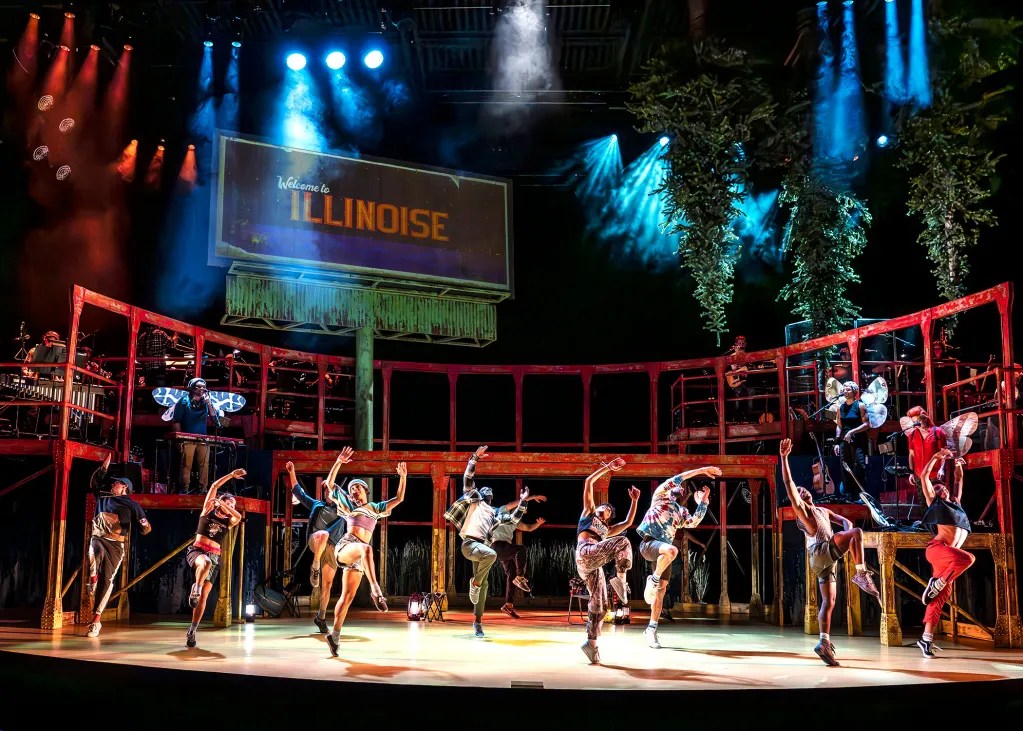
The ensemble cast of dancers backdropped by musicians and winged vocalists in ‘Illinoise’.
I almost feel guilty recommending such a perfect piece of theater when it’s almost too late to see it. Illinoise leaves Broadway on August 10th, and it was by far my favorite thing I’ve seen on stage in my life. Do I recommend it? Yes. Kind of.
Illinoise is the Broadway adaptation of Sufjan Stevens’ 2005 album Illinois. Illinois is a concept album which romantically portrays the history of the state, interwoven with personal stories from the narrators of each song, who can be seen as separate from Sufjan.
Illinoise takes this lightly touched upon topic, the multiple narrators of the studio album, and brings it to the forefront. Reimagining the arrangement and order of the studio album’s songs as campfire stories told between friends and loved ones.
For those already familiar with the album, this change in arrangement and order can tell you exactly what makes the cast recording fresh. But, if you haven’t already listened to the album, I can’t see any reason for you to listen to the cast recording of the musical.
The show is brought to life on stage by the cast of the musical, all of whom interpretively dance to the music playing just fifteen feet above them. The songs are given to storytellers, reading from journals (aside from the later half, which is dedicated in its entirety to a single narrator). In turn, each journal-clad dancer gets to lead their own number.
These journal-clad dancers physicality makes each song into a beautiful visual experience, like the lovingly reimagined “Zombies” (on Illinois, They Are Night Zombies!! They Are Neighbors!! They Have Come Back from the Dead!! Ahhhh!).
“Zombies” depicts in its choreography the way we resurrect the dead in politics today. A horde of undead chase one of the dancers, torturing her with the folksy sounds of Sufjan Stevens’ jamboree-esque tune. These dead, after catching her, reveal their names with convenient placards, and make the song’s meaning clear. The signs read Andrew Jackson, Ronald Reagan, McCarthy, before being cast away by the horde. As they revealed themselves, my crowd broke into a small applause, more akin to a gasp.
But “Jacksonville” is by far the most reimagined song from the musical adaptation. The stage changes the meaning of the song with clever set-dressing, lighting, and costuming, then adds entire segments of tap-dancing percussion to the already warm track. Tap-dancing which is almost silent in the cast-recording.
Which is why I must tentatively say I can only kind of recommend Illinoise.
The cast recording can only do so much to communicate the wonder of this musical, and without a pro-shot of the show, I can’t really recommend the experience to anyone unable to see it in-person.
Still, Illinoise is the best stage production I’ve seen in my lifetime, and if you’re in New York before it closes on August 10th, you should see it too.
(If not, I do recommend watching at least watching the cast performance of “Jacksonville” on Colbert here)
Angels in America – Tony Kushner

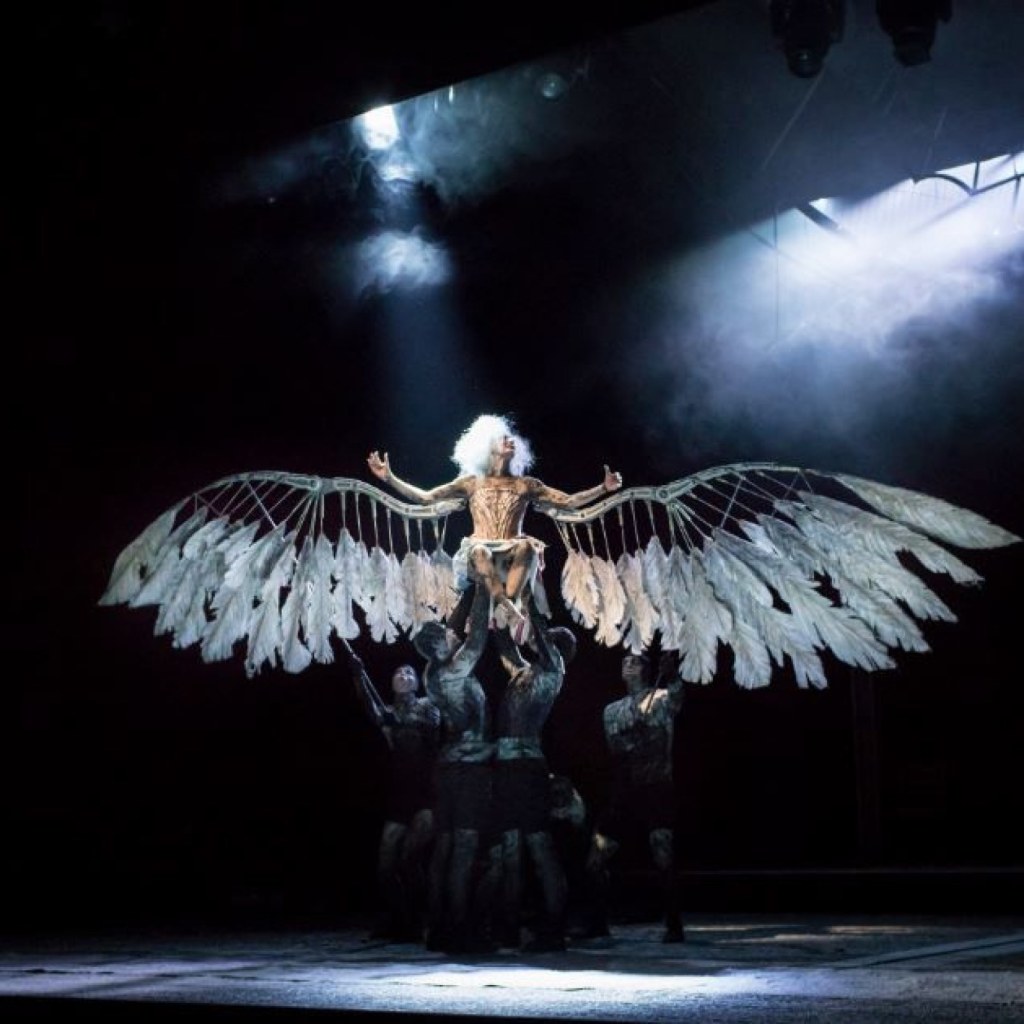
Andrew Garfield delivering the final monologue in the 2018 production of Angels in America
Angels in America is a six-act play about gay men living in New York in the 80s and mormons. Tony Kushner said “The process of writing the play [was] the process of discovering the subterranean connections between these things.”
This play is a Pulitzer Prize winning, Tony Award winning, tour de force in dialogue and metaphor. Do I recommend—yeah I really do.
I’ve read three Kushner plays this summer and it’s become clear my taste is a little boring. I’m still thinking about Angels in America the most. And not even the interesting bits! Not the angels with choirs of sexual organs, or the prophet with three painted nails dying of AIDs, or even a young Donald Trump’s legal council writhing on the third floor of a hospital.
I keep picturing New York in 1986, and the men brave enough to keep walking its streets. These men weren’t inherently good because they survived, but they were undoubtably brave. They were surrounded by headlines and enemies. But still, they went to work, they cut out coupons, they exercised, and they held onto what they could, if only their image.
I see it in acrylic paint, men walking up stairs in sleek raincoats imbibing AZT. Below them, waiting at a bus stop, are men in less. Naked in the pouring rain, these men are covered in clear latex and nonoxynol-9 maintaining a brave face. And even below them in a subway tunnel are men in suits proudly reading Revelation, Exodus, Leviticus, or their apocrypha of choice. It’s hard for me to empathize with those men.
Louis comes to mind as I look at the painting. He’s a pathetic man, quick to tears, and quick to abandon the man he loves when an AIDs diagnosis appears. I think Louis’s purpose in Angels in America is to be detestable. But, Louis is most certainly at the ground floor of my mental image.
Louis is a bleeding heart liberal who spends his days bedding a mormon clerk, a clerk named Joe who works beneath Roy Cohn. Joe was somewhere beside the MTA’s information booth before Louis led him to the ground floor, and for maybe a month, they’re happy there. But, somewhere in this happiness, Louis found his spine.
In Part II, Act IV, Louis takes a stand for his beliefs against Joe. “Have you no decency?” He reviews the decisions clerked by Joe, and finds them riddled with the derisive and hateful conservatism flourishing during Reagan’s presidency. “Have you no decency?” He even uncovers Joe’s connection to Roy Cohn, the “Killer Queen” herself. “Have you no decency?” All while hammering the words of Joseph Welch into Joe’s head, fully abandoning this project, and pushing Joe beneath the streets of New York City. For this, Joe beats Louis bloody.
Louis says: “It’s like a sex scene in an Ayn Rand novel, huh?”
Louis is my favorite character in Angels in America, and the one I am most horrified to relate to. But, I think Kushner related to Louis too. It’s hard for me to defend this claim; even after reading a handful of forewords and listening to decades of interviews, I can’t say it with any confidence, but I still think it.
I’ve noticed when critics look at a piece for weeks, months, or years, they tend to describe it like its alive. The play breathes, bleeds, and smiles at the critic. But Angels in America is still just a painting to me. An acrylic piece burning a hole in my skull. But when I look at the painting, I can’t help but feel that the sleek black raincoats were never Kushner’s style. Kushner knew how awful it felt to be naked in the rain.
Laity Lodge Youth Camp

“Comedy is okay, but clown? Is more difficult.”
A short but significant part of my summer was spent at LLYC. I got the time to write, the space to see stars for the first time in months, and the opportunity to pursue my real passion, clowning.
It doesn’t feel right to reflect on or recommend camp like it’s a work of art, but I do want to write about it somehow, so instead I’ll just share my favorite story I was told at camp.
I was on the porch of my cabin, and I had a book in my hands. The sun was blinding, so I couldn’t quite see beyond the porch. Rushing through this light, one of my campers ran up to me and says “Hey, want to hear the story of how I met my second crush?”
I gave him a vague nod, so then he takes a deep breath and goes:
“This is the story of how I met my second crush. At a camp I go to, during lunch, a girl came up behind me and tapped me on the shoulder. She said ‘I love you.’ And even though I was told by one of her friends next to her that they were playing truth or dare, and she was dared to say that, I said: ‘I know how you feel.’ Because I’ve been scared to say what I feel before too.”
He delivers this whole monologue in one take, barely stopping to take a breath. It’s honestly somewhat unsettling, it felt like he was taken over. Like one of the muses decided to inspire him with a minute of cogent, salient, thoughtful language before almost immediately returning him to flaming chaos.
I tried to get him to tell the story again, but he never got the words right.
 Catterton Scribes
Leave a comment