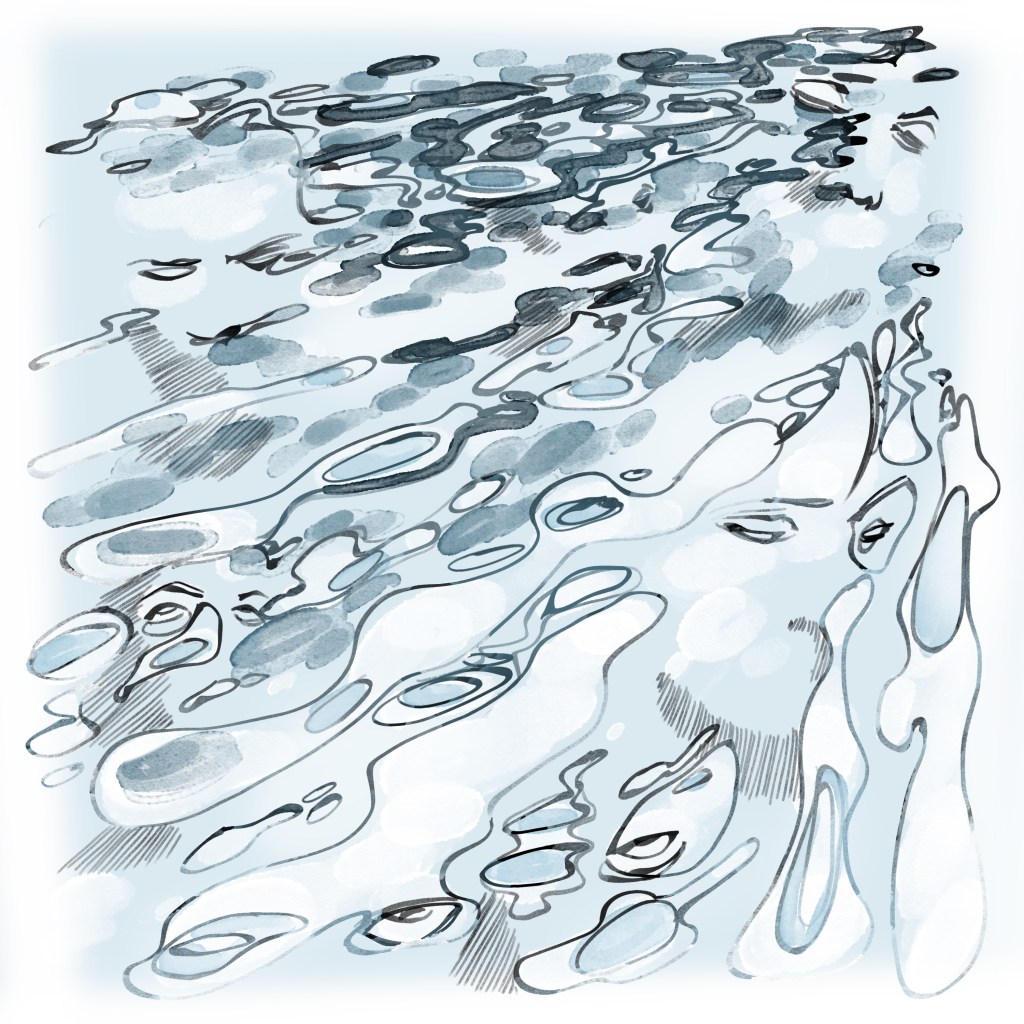
(Something Ocean-y, by Flora Smith)
The storage unit softly sung its hourly creaks and moans as the ship shifted far-tide. Broad-side.
“Girlfriend breakup with you?” His manager shouted up half-heartedly. With a forced smile, he said: “Why don’t you just, get down from there now? Okay?”
The man ignored his order and retrieved something from his jacket. A journal. It was full of sketches—sketches of distant strips of land and whiney coworkers. Anything he could see in the worlds available to him.
A broken phone laid beside his bed, plugged into a now purposeless charger.
He looked down from the stacked shipping containers and saw magnificent waves slam into the steel wings of the beast. The white thrush of foam bubbled up sea-smelling air. The pen came to his hands quickly but his mind drifted away just as quick. The sound of the waves became too grating—too common—for him to meditate upon. He slid his pen back into his pocket and his journal to his breast. With a dramatic turn he mounted the ladder behind him.
One hand went under the other. Gray waves with a crosshatched interior coated in imagined trails of color on the blank white page. He committed the sight to his mind best he could, then fell to his feet.
“Now,” His manager clasped his hand on the man’s shoulder. “Don’t you do that again.”
The man looked down deferentially and found himself quite wet. Barrel-chested as he was, he thought about what the folds of his stomach and thighs might collect. He knew exactly where his drawings of bright red ringworm and pockmarking blood-boils were hidden within his little black book. The man shook his hat dry, then turned his ear to the ground as his manager blustered his way back into speech, this time using his serious voice.
“Next time I see some shit like that, I’ll martial yah.”
The ship beneath them was not a military carrier. His manager just liked to sway his southern lilt toward a navy tilt. He enjoyed the thought of the isolation giving him a truer form of power, because though he might be old, he had legs for the sea and a big voice. When home he was subject to the demands of his doting daughter and when abroad he was subject to the charges of any number of sex workers. Like a shocking number of his crewmates (his inferiors), the manager had a poisonous, red-spotted snake between his legs.
“Well…” His manager furrowed his brow, searching for a calmer end to their conversation. “Just get back to work.”
The man nodded again and walked past his manager as quickly as he could. He did not like garnering attention in any circumstance, but his need for new images had grown so dire that he felt he must, because he is not an artist.
An artist can create something from nothing. They are divine. He cannot create anything without reference. He isn’t even sure he can truly think; it’s just black when he closes his eyes.
…
He picked and prodded through his lunch: A tray with Salisbury steak, mashed potatoes, peas and carrots. It had the same structure and taste as a TV dinner, though no one on the ship was mentally fit enough to care. Enough early mornings and seasick evenings bought these boys a monastic taste in grub—rice porridge filled with flies and maggots would’ve done them just as good.
Dug beneath his elbow (as to stop it from sliding into another sailor’s plate) his still-open journal waited for him. In the last week he’d drawn the waves to death. His pen had run out of ink, forcing him to make another run to the bridge and offer up another shallow excuse to seize his instrument from their tight, bureaucratic assholes. Only a day after that did he finish his waves, his eighteenth draft proving unconquerable at his current skill-level.
He carefully assembled a picture in his food. In two even halves like a pie chart based on 10,000 coin flips, he brought order to his lunch. On the left, crushed and minced steak wove into his wet mashed potatoes, thread in skin. On the right, a wall of square carrots with ever-rolling peas spilling out, organs on the floor.
He lifted his elbow off his journal and immediately went to work, sketching out the finest details of his piece with a level of exactitude that could only discomfort its viewer. A man at his table wearing a baseball cap with dip in his lip leaned over to observe him and promptly stood from his seat.
Walking over to a crowded table, the man with a baseball cap sat down and introduced himself with an anecdotal slur and a point toward the freak with a notebook. The other men laughed and he found community in that sound. The man with a baseball cap was lonely. So, so lonely.
The man watched the explosion of laughter with a neutral expression. Artists persist in spite of their detractors. He closed his notebook and stormed off.
The meal schedule rotates on a weekly basis. Mondays are Salisbury steak, Sundays are square cut pizza, etc. The man’s geometrics and edible displays could only hold his attention for so long.
…
He could not help but stay awake. Every week the man fell deeper into his obsession and in his search for images he once again went to the shipping containers, this time to explore their insides.
In the pitch night, he first opened the red shipping containers with blue logos. Inside, he found medical supplies. Syringes, tourniquets, cloth bandages and plaster went into his notebook. In the red container, he committed his first explorations of the body to the page. In the dark of the night, he took a syringe from a large crate and filled it with his own blood. He thought to add it to the page then remembered the brown metal smelling afterimage it left when dried. Instead, he opted to place the syringe on his bedside (right above his destroyed phone) and sketched it. He sketched the bandage he wrapped around his arm as well. He sketched every environment and object available, but ran out much too soon.
The man grew in talent and boldness. He started breaking into the containers during the evenings as well.
He opened the blue shipping containers with the white logos that shone orange in the setting sun. Complimentary colors. Inside were bed-sets. The bed-sets packaging said they were linen, but the oversheets and especially the pillowcases did not feel like linen. He attempted to turn a pillowcase into a canvas, but the ink of the ballpoint could not attach itself to the “linen” sheets. The man noted down the brand name for this exact reason.
Next, he opened the gray shipping containers with black logos. More large crates, this time filled within small wooden figurines. After sneaking some, he splayed out their arms and legs and placed them beneath his bed, as if they were crawling further into the darkness.
Like a little kid, he thought. Crawling under the bed for safety from me and my pen.
…
He was caught breaking into the green shipping container. In the hubbub of his detention (and his manager’s corporate rendition of a “court martial”), his manager did not let him see what was inside. This bothered the man more than being caught.
The man’s pay was docked for each lock he broke and each crate he disturbed. He sat even lonelier at meal times and was no longer permitted to enter the bridge, let alone borrow a pen.
Every behavior he exhibited was closely monitored by his supervisor, his supervisor’s supervisor, and the court of public opinion. It was common knowledge at this point that he would be charged with theft as soon as they reached the mainland. He was a prisoner on the vessel, permitted to work only to pay for the cheap things he broke.
If the man left his station, his manager followed him. No matter the circumstance. So when the man loudly announced he had to take a piss, his manager followed without question.
It was raining. Their footsteps displaced puddles and made beautiful, reflexive bursts of light-catching water droplets. An impulsive regret flashed across the man’s mind. He wished more than anything that he had a pen to capture the image, but he knew he had to make do with the syringe despite its lack of delicacy.
His manager followed him into the restroom, clarifying that he needed to drain the snake. Both men placed themselves in front of a urinal. The manager unzipped his fly and fished his penis through the hole.
“Fuck,” The manager groaned. He thought about the shot of penicillin he’d need when he reached the shore. “It never stops, does it?”
He turned his head to share some camaraderie with the freak only to find empty space.
He tried to stop the stream, but the burning between his legs bloomed into a roaring flame. He couldn’t turn around while he was still like this; his pride didn’t let him.
Crashing thunder filled the room. The manager shook his penis, trying desperately to get every drop out so he could investigate the sound.
Behind him, the man moved so slow he might as well have crawled. In his hands was a steel paper towel dispenser, loosened after many days fingernail splitting effort. No one had noticed his blisters and his bloody quick in their near-constant surveillance of the man.
The man came down on his manager with great force, slamming the dispenser into his head till he fell to the ground. He was happy it came off the wall before the ship was docked. There was a special satisfaction hidden under his brutality. When the deed was done, he dropped the bloody dispenser carelessly beside him.
From his breast pocket he withdrew his journal and the syringe. He squatted down and stripped his manager’s jacket and shirt off his body. From his corpse the man withdrew a milliliter of blood before bringing the syringe to his own arm too.
Feeling the stings of the needle as he searched for the vein, he tried to summon a narrative for why he had done this. Why do I even need a reason? The man thought.
He pulled the plunger up, mixing his and his supervisor’s blood. He froze with a satisfied smile and took a deep breath, closing his eyes and surrendering himself to his mind. He saw a small apple, completely unique to any he had seen before. Then the vial, filled with blue liquid. Then the face of woman he had never seen before.
…
A Houston Chronicle article released within the week. It’s headline was tasteless (“Slaughter at Sea: Suspect in Carrier Killing Pleas Insanity”) and its content was hardly better. The page was substantively empty, just a wall of summary followed by a hundred words of bland commentary, most of which hinged upon true-crime trope and insistent links to other articles on the newspaper’s website.
When finally brought to print and brought to the man in custody by his mother, the piece was fluffed up. Right beneath the man’s greatest artistic expression sat trite takes on mental health, labor, and concerning AI usage uncovered from his broken phone.
All of this paired with the new bee-sting between his legs drew out something deep within the man. He unfolded the newspaper and tore out his page. The remnants of the rag were thrown into the open toilet within his cell. His article wasn’t even large enough to take up the whole page. He had to share it with another.
With a sharp voice and indelicate tones, he screamed out the first name he saw on the page. “Christian Dobson!” His voice rang through the county jail.
A prison guard assigned to patrol the hall turned up the volume in his earbuds.
Dobson’s most recent Atlantic-bait took the top half of the page. Beneath his accreditation, a detailed account of modernized conversion-camp strategies employed by an ever-growing and digitized clergy. Awkward mentions of social media handles were everywhere and so was the the name of the primary source.
“Micah Arbaugh!” The man roared, stomping over to his bed and slamming his fists into its springs.
Despite the frequent mentions of the congregation’s many accounts and websites, Dobson’s article never mentioned the head pastor’s name. Micah Arbaugh was named in nearly every paragraph.
The man read past the piece and finally reached the trashy title of his own article. There he met the author of his artist’s statement, the one who should write the placard beside his future piece at the MOMA.
“Steven Teagues!” Sea foam bubbled inside of the man’s mouth—he wanted to vomit.
His eyes tore through the rest of the article scanning and scanning for some evidence of himself in the piece. The suspect, it read. The sailor, the suspect, the man.
“Please, Teagues,” The man prayed. “You have to tell them my name.”


Leave a Reply